Jonathon Tanks
Who says sustainable materials have to be low-performance, or that high-performance materials can't be sustainable? Let's change that!

Senior Researcher
NIMS, Japan
Research Interests
My research strategy is to combine experiment and theory (at multiple length and time scales) to probe and explain processing-structure-property relationships in polymeric and nanomaterials at the interface of chemistry and physics and to use those findings to develop high-performance and multifunctional materials and end-of-life recycling/reuse technology. As a research scientist at NIMS, I develop polymers and composites for sustainable and multifunctional structures, investigating their degradation behavior and how it relates to recycling and material design. My main research areas with examples of recent activity are summarized below.
- Creation of sustainable polymers/composites for high-performance and functional applications (biomass/plastic blends, hybrid fibers, CO2 utilization).
- Development of processes for resource recovery and utilization by leveraging solvent mixtures (commodity plastics/fibers, batteries, biomass, graphite).
- Structural control via molecular design and processing conditions to enhance functionality and recyclability in polymeric materials (crystal orientation, reversible bonding).
Background
I started out wanting to be an architect in high school and transitioning to structural engineering in undergrad…which made me realize I found the fundamental mechanical behavior of materials more interesting than the buildings and bridges that contain them. From there, I turned my focus toward the influence of environmental exposure on the mechanical behavior and reliability of composites as part of my master’s thesis, which sparked an interest in degradation phenomena.
My training in martial arts–particularly karate–brought me into contact with Japanese culture and history, but I never thought I would get a chance to actually visit Japan. But once I decided to pursue a PhD, I knew it would be a once-in-a-lifetime opportunity to live in a foreign country for at least three years, so I chose the Tokyo Institute of Technology as my #1 choice. Beyond all odds–I got accepted with financial support from the MEXT Graduate Fellowship.
At Tokyo Tech, I began studying how epoxy resins–which are used in everything from airplane fuselage to circuit boards to protective coatings–degrade in acidic environments, with a focus on how the structure/properties of the epoxy influence the overall degradation kinetics with the goal of developing lifetime prediction models. During this time, I also worked with Prof. Yoshihiko Arao (now at Waseda Univesrity) in the development of graphene nanocomposites for high-performance and functional applications.
In the end, I joined NIMS as a research scientist in 2019 and have been striving to make an impact on society through the development and characterization of sustainable and functional composite materials.
news
| Mar 04, 2026 | [Conference] I presented our work on lignin/nylon thermal stability, and Mr. Kuwata (Waseda) presented our work on thermally conductive composites at JCCM-17 in Osaka, JP. |
|---|---|
| Feb 10, 2026 | [Funding] My proposal for industry collaboration was accepted. |
| Jan 20, 2026 | [Conference] My presentation on disulfide-intercalated nanosheets was selected for a poster award at ClaySymp-68. |
| Dec 05, 2025 | [Conference] My presentation on nylon recycling was selected for a poster award at PMF-34. |
| Dec 05, 2025 | [Conference] I presented our work on nylon recycling at PolyMatForum-34 in Nagoya, JP. |
selected publications
- Biomass
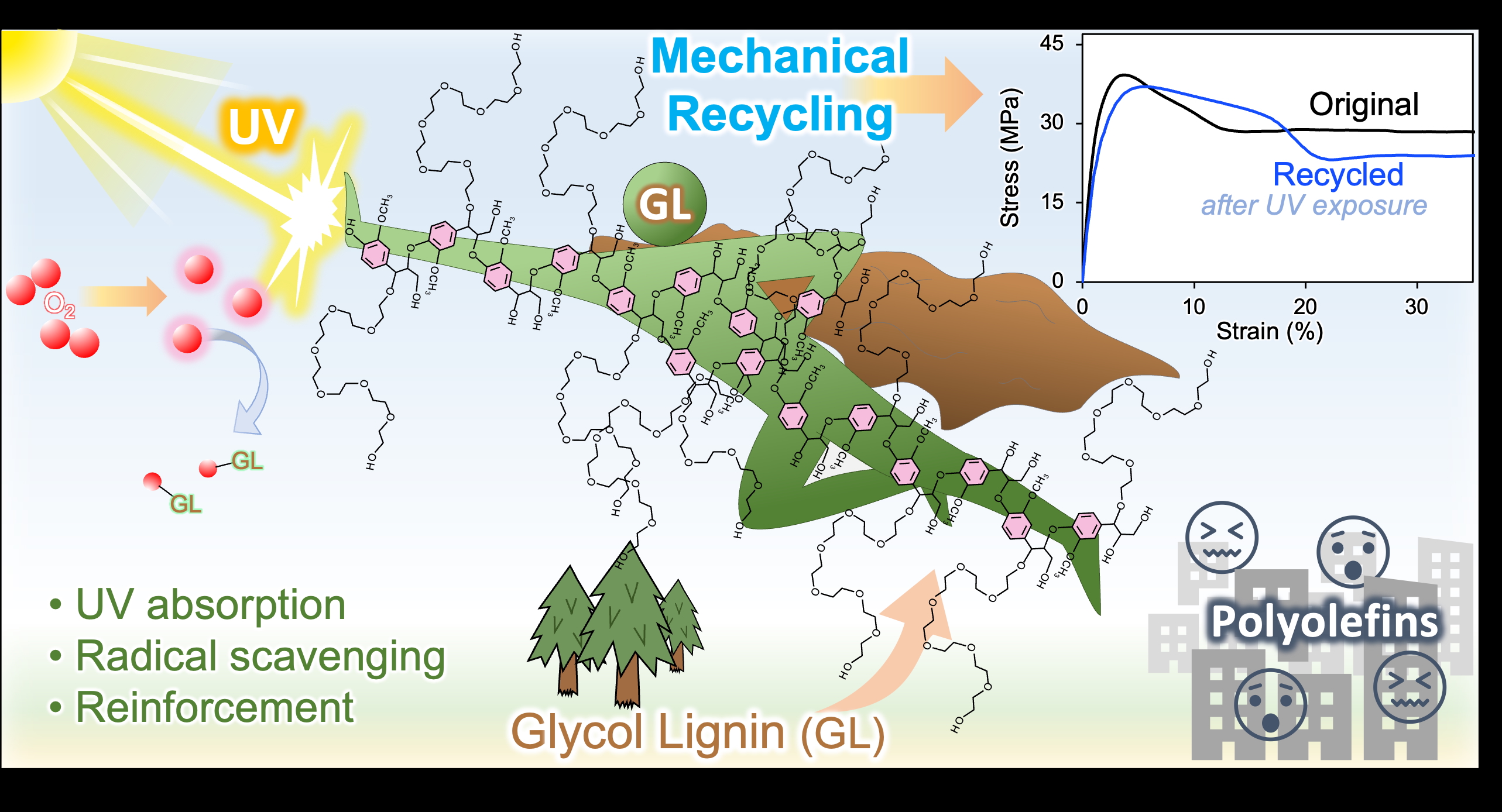 Durable and recyclable biomimetic glycol lignin/polyolefin compounds for a circular economyJournal of Materials Chemistry A, 2024
